
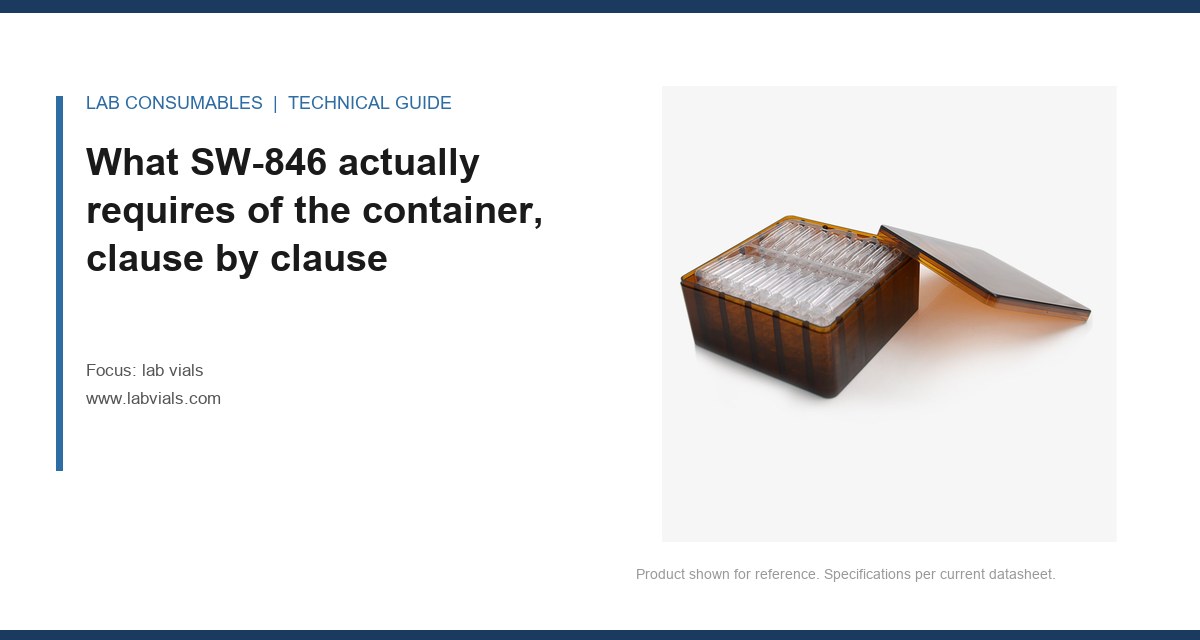
The auditor asked for the container blank log first, before the calibration records, before the chain-of-custody forms. The lab had 14 days of holding time left on a set of soil extracts and no documented evidence that the 40 mL VOA vials had been checked for headspace or that the septa had been lot-traceable. The corrective action ran to nine pages. None of it had anything to do with the analytical method itself. All of it came down to what the EPA method requirements for lab vials actually say, and what the auditor expects to see on paper when they arrive.
This is the part of a method compliance audit that labs underestimate. The chromatographic data can be perfect. The container documentation is what gets written up.
SW-846 is not a single method. It is a compendium, and the container requirements sit in the SW-846 test methods at three levels: the individual method (e.g., 8260, 8270, 8081), Chapter Three (inorganic analytes), Chapter Four (organic analytes), and the sampling guidance in the 8000-series introductions. Auditors read all of them together because the container requirement is distributed.
What the text actually says, in plain terms:
- Material: amber glass for most organic methods. Method 8260 specifies glass with a PTFE-lined septum or a screw cap with a PTFE-faced silicone septum. Method 8270 tolerates amber glass with PTFE-lined caps. Method 8081 is stricter: no plastic, no colored glass that could mask a phase change.
- Volume: the method states a minimum. 8260 wants 40 mL for a VOA vial with zero headspace, and two vials per sample (one for screening, one for confirmation). 8270 wants 1 L amber glass. 8081 wants 1 L amber glass with PTFE-lined cap.
- Headspace: 8260 requires zero headspace, defined as a meniscus that does not break when the vial is inverted. This is a physical check, not a paperwork check.
- Preservation: HCl to pH <2 for 8260 and 8270, measured with narrow-range pH paper or a meter after transfer. The method says “check with pH paper” and the auditor will ask for the log entry with the analyst initials and the date.
- Holding time: 14 days from collection for most 8000-series organics, 7 days for 8081 and 8151, 28 days for some inorganics. The clock starts at collection, not at receipt.
Notice what is not in the method text: no specification for septum durometer, no torque value for the cap, no requirement for a certificate of analysis from the vial supplier. That absence is where labs get into trouble, because the auditor fills the gap with expectation, not with the letter of the method.
The gap between “method says” and “auditor expects”
I have sat through enough of these to know the pattern. The method gives you the floor. The auditor gives you the ceiling. The ceiling is built from three things: the method text, the lab’s own SOP, and the supplier documentation the lab can produce on demand. If the SOP says “40 mL amber VOA vial with PTFE-lined septum,” the auditor will ask which supplier, which lot, and what evidence exists that the lot met the SOP. If the SOP says nothing, the auditor will default to the method and then ask why the SOP is silent.
Either way, the lab needs the paperwork. The question is what paperwork, and in what order.
The five documents an auditor asks for first, in the order they ask
I have watched this sequence enough times to know it is nearly invariant. The auditor sits down, opens the binder, and works through it in this order. Have them ready and the audit moves quickly. Fumble the first one and the auditor slows down, because a lab that cannot produce a container blank log is a lab that probably has other gaps.
- Container blank and trip blank log. The auditor wants to see that blanks were prepared in the same container type, from the same lot, and analyzed with the same method. For 8260, the trip blank is a 40 mL VOA vial filled with reagent water at the lab, sealed, and shipped with the samples. The log needs the lot number of the vial, the lot of the septum, the date prepared, and the analytical result. If the trip blank came back with a 2 µg/L methylene chloride hit, the auditor will ask which lot of septa and which lot of vials and whether the lab investigated.
- Vial and septum certificate of analysis. Not the marketing sheet. The CoA with the lot number, the material specification, and the test data. For a PTFE-lined silicone septum, that means durometer (typically 45 to 55 Shore A), thickness (typically 0.060 in or 1.5 mm), and a statement about extractables. For the vial, the CoA should state glass type (Type I borosilicate for most methods), the 24-400 GPI thread finish, and the dimensional tolerance on the ID and the height.
- Holding time and preservation records. The auditor will pull three or four sample records at random and check the collection date, the receipt date, the extraction date, and the analysis date against the method holding time. They will also check the pH log. If the pH was not recorded, the auditor will treat the preservation as unverified and the data as suspect.
- Chain-of-custody forms. The auditor checks that the container count on the CoC matches the container count in the log matches the container count in the analytical batch. A one-vial discrepancy on a 40 mL VOA sample is enough to trigger a finding, because the method requires two vials and the lab cannot prove the second one existed.
- The SOP that governs all of the above. The auditor reads the SOP last and checks that it matches what the lab actually did. If the SOP says “amber glass, PTFE-lined cap” and the bench used a septa with a silicone face and no PTFE barrier, that is a finding regardless of whether the data are good.
Notice that only one of those five is about the analysis. The other four are about the container and the paper trail behind it. That ratio is the whole point of this article.
The container blank is not a formality, and auditors know it
A container blank is a volume of reagent water or clean matrix placed in the same container type, from the same lot, and carried through the same handling as the samples. It is the only control that isolates the container as a source of contamination. The method text for 8260 and 8270 requires it. The auditor will check that the blank was prepared from the same lot of vials as the samples, not from a different lot that happened to be on the shelf.
Here is the failure mode I have seen most often. The lab prepares the container blank from a fresh case of vials opened for the purpose, while the samples went into a case that had been open on the bench for three weeks. The blank comes back clean. The samples come back with a low-level hit of toluene or methylene chloride. The lab blames the samples. The auditor asks which lot the blank came from and the answer is “a different one.” That is a finding, because the blank does not represent the container the samples actually touched.
The fix is procedural, not analytical. Open one case, log the lot, and use that lot for both the samples and the blank. If the case runs out mid-batch, open a second case, log it, and prepare a second container blank. The extra blank costs one 40 mL vial and 40 mL of reagent water. The finding costs a corrective action and, in a worst case, a re-sample.
What a clean container blank actually proves, and what it does not
A clean container blank proves the lot was not contaminated at the level the method can detect. It does not prove the septum will not shed a fragment when the autosampler needle punches it. It does not prove the cap will hold pressure during a heated headspace run. Those are physical properties, and the auditor will look for them in the CoA and in the lab’s own incoming inspection records, not in the blank.
This is where a lot of labs get caught. The blank is clean, the CoA is on file, and the auditor still writes a finding because there is no record of incoming inspection. The auditor’s expectation is that the lab verified the container on receipt, not just that the supplier verified it at manufacture.
Incoming inspection: the record the auditor expects and most labs do not have
I will be direct. Most labs I have walked through do not have an incoming inspection record for vials and septa. They have a receiving log with a date and a quantity. That is not inspection. The auditor knows the difference.
What the auditor expects to see, at minimum:
- Lot number recorded on receipt, matched to the CoA on file.
- Visual check for chips, cracks, and cap damage, with the sample size stated (e.g., “10 vials per case inspected, zero defects”).
- Dimensional check on a sample of vials: OD, height, and thread finish. For a 24-400 GPI finish, the thread OD should be within ±0.015 in of nominal. A vial that is out of round by more than that will not seal reliably with a standard cap.
- Septum check on a sample: thickness and durometer, or at minimum a physical inspection for liner separation. A PTFE-faced septum with a visible gap between the PTFE film and the silicone body will fail during a heated run.
- Functional check: fill one vial with reagent water, cap it, invert it, and confirm no leak and no headspace bubble. This takes 30 seconds and catches the most common defect.
That is a five-line form. It takes about two minutes per case. The auditor will accept it. What the auditor will not accept is a receiving log with a date and a quantity and no inspection data, because that log does not demonstrate the lab exercised control over the container.
The dimensional check that catches the most defects
The single most useful incoming inspection measurement is the vial height and the cap thread engagement. A 40 mL VOA vial is nominally 27.5 mm OD by 95 mm height with a 24-400 finish. If the height drifts by more than 1 mm, the autosampler on a headspace or purge-and-trap system may not seat the vial correctly, and the needle will punch off-center. Off-center puncture is the leading cause of septum coring, and coring is the leading cause of the ghost peak that shows up in the blank three runs later.
I have seen a lot of vials arrive 1.5 mm tall. The supplier’s tolerance was ±1.0 mm and the lot was within spec, but the lab’s autosampler had a 0.5 mm seating tolerance. The vials worked on the manual prep bench and failed on the instrument. The fix was to add a height check to incoming inspection and reject lots outside ±0.5 mm. The supplier was not at fault. The lab had never specified the tighter tolerance.
Two field cases where the container paperwork, not the chemistry, drove the finding
Case 1: the trip blank that came back at 3 µg/L
A lab running 8260 had a trip blank come back at 3 µg/L methylene chloride on a batch of groundwater samples. The samples were clean. The lab re-ran the blank and got 2.8 µg/L on the second run. The analyst suspected the reagent water and replaced it. The third run came back at 3.1 µg/L.
The measurement that identified the cause was a septum lot comparison. The lab pulled the CoA for the septum lot and found it was a 0.060 in PTFE-faced silicone with a durometer of 40 Shore A, softer than the 50 Shore A the lab had used previously. The softer septum was more prone to compression set under the cap, and the PTFE face was separating slightly at the edge, exposing the silicone to the headspace. The methylene chloride was coming from the silicone, not the water.
The fix: the lab specified 50 Shore A minimum durometer and a 0.005 in minimum PTFE face thickness in the purchasing spec, and added a septum compression test to incoming inspection (cap a vial, torque to 8 in-lb, hold 24 hours, inspect for face separation). The trip blank came back non-detect on the next batch.
Case 2: the holding time that started at the wrong end
A different lab had a set of soil samples for 8270 with a 14-day holding time. The collection date on the CoC was day zero. The extraction happened on day 12. The analysis happened on day 15. The auditor flagged the three-day overrun as a holding time exceedance and the data were qualified.
The lab’s defense was that the samples had been in the 1 L amber glass containers the whole time and the containers were sealed. That defense does not work. The holding time in 8270 runs from collection to extraction, not collection to analysis, and the extraction is what stops the clock. The lab had confused the two clocks.
The measurement that identified the problem was a simple date arithmetic check on the batch: collection date, extraction date, and the method holding time, run as a query against the LIMS. The lab added that query as a batch release check. It now runs before any data are reported, and it has caught four potential exceedances in the eighteen months since.
The comparison table: what the method requires vs. what the auditor checks
This table is the one I hand to lab managers who ask what to prepare. The left column is the method text. The right column is what the auditor actually asks for. The gap between them is the preparation list.
| Item | Method requirement (SW-846) | Auditor expectation | Evidence to have ready |
|---|---|---|---|
| Container material | Amber glass, PTFE-lined septum (8260, 8270, 8081) | Supplier CoA on file, matched to lot used | CoA with lot number, glass type, septum spec |
| Container volume | 40 mL (8260), 1 L (8270, 8081) | Volume verified on receipt, not assumed | Incoming inspection record with measured volume or weight |
| Headspace | Zero for 8260, meniscus check | Documented check at collection, not at receipt | Field log entry with analyst initials and time |
| Preservation | pH <2 with HCl, checked with pH paper | pH recorded per sample, not per batch | pH log with date, analyst, and reading |
| Holding time | 14 days (8260, 8270), 7 days (8081) | Clock verified before extraction | LIMS query or batch release check |
| Container blank | Required, same lot as samples | Same lot, documented, result reviewed | Blank log with lot number and result |
| Septum specification | PTFE-faced silicone, no durometer stated | Durometer and thickness on file | CoA plus incoming inspection measurement |
| Cap torque | Not stated | Consistent application, documented if questioned | SOP with torque value (typically 6 to 10 in-lb for 24-400) |
Two rows in that table have no method requirement at all: septum durometer and cap torque. Those are the two the auditor asks about most often, because the method is silent and the auditor wants to know the lab has a defensible position. The defensible position is a written spec and an incoming inspection record.
The cap torque question, and why 8 in-lb is the number I use
For a 24-400 screw-thread vial with a PTFE-faced silicone septum, I specify 6 to 10 in-lb of applied torque, with 8 in-lb as the target. Below 6 in-lb, the septum does not compress enough to seal against the vial land, and you get leaks during heated headspace runs. Above 10 in-lb, the septum compresses past its recovery point, the PTFE face wrinkles, and you get coring on the next puncture. The 8 in-lb target is the midpoint that gives you margin on both sides.
The method does not state a torque value. The auditor will not ask for one unless the lab has had a leak finding, at which point the auditor will ask what torque the lab applies and whether it is documented. The answer should be a number, in the SOP, with the torque wrench or the calibrated capper identified. “Hand tight” is not a number, and the auditor knows it.
For labs running a lot of 40 mL VOA vials, a calibrated torque capper pays for itself in reduced leak findings. The VOA vial lines from the major suppliers are dimensionally consistent enough that a single torque setting works across lots, provided the incoming inspection catches the outliers. The lab vials catalog at labvials.com lists the GPI finish and the dimensional tolerance for each product, which is the starting point for the purchasing spec.
The SOP is the document that ties the rest together
The auditor reads the SOP last because the SOP is the lab’s own statement of how it meets the method. If the SOP is silent on a point, the auditor defaults to the method. If the SOP contradicts the method, that is a finding. If the SOP matches the method and the lab can show it followed the SOP, the audit closes.
What the SOP needs to state, at minimum, for vial handling:
- The container type and material for each method, by method number.
- The septum specification, including durometer and PTFE face thickness.
- The cap torque value and the tool used to apply it.
- The incoming inspection procedure, with sample size and acceptance criteria.
- The container blank procedure, including the requirement to use the same lot as the samples.
- The holding time for each method, with the clock start point stated explicitly.
- The preservation procedure, with the pH target and the measurement method.
Seven bullets. The SOP does not need to be long. It needs to be specific enough that an auditor can check the lab’s records against it line by line. I have seen a two-page SOP pass an audit that a twelve-page SOP failed, because the two-page version had numbers and the twelve-page version had adjectives.
Where the supplier documentation fits
The supplier CoA is not a substitute for the SOP. It is evidence that the container met the spec the SOP defines. The auditor wants both: the SOP that states the spec, and the CoA that shows the lot met it. A lab with a CoA and no SOP has no defensible spec. A lab with an SOP and no CoA has no evidence the lot complied. You need both, and the Aijiren line is one I have used for exactly this reason: the CoA is lot-specific and states the durometer and the GPI finish, which is what the auditor asks for.
A pre-audit checklist that fits on one page
Run this two weeks before the auditor arrives. Every item is a document, not an analysis.
- Pull the container blank and trip blank logs for the last 12 months. Confirm every blank has a vial lot number and a septum lot number.
- Pull the CoA for every vial and septum lot used in the last 12 months. Confirm each CoA states the material, the durometer (septa), and the GPI finish (vials).
- Pull the incoming inspection records. Confirm each case has a visual check, a dimensional check, and a functional check, with the sample size stated.
- Pull the SOP. Confirm it states the torque value, the septum spec, the holding time clock start, and the pH target.
- Run the holding time query against the last 6 months of batches. Confirm no batch exceeded the method holding time between collection and extraction.
- Pull the pH logs for the last 3 months. Confirm every sample has a recorded pH, not a per-batch note.
- Confirm the container count on the CoC matches the container count in the analytical batch for a random sample of 10 batches.
If all seven pass, the auditor will move to the analytical data quickly. If any one fails, fix it before the auditor arrives, because the auditor will find it and the finding will be about the container, not the chromatography.
The decision rule
If your lab cannot produce, within five minutes of being asked, the vial lot number, the septum durometer, the cap torque value, and the container blank result for any given batch, you are not ready for an audit. The EPA method requirements for lab vials are the floor. The auditor’s expectation is the ceiling, and the ceiling is built from a written spec, a lot-specific CoA, an incoming inspection record, and a container blank from the same lot. Get those four in place and the container stops being the thing that gets written up. The Agilent and Thermo Fisher consumable lines both publish the dimensional and material specs you need for the purchasing spec, and Restek publishes the septum compatibility data that backs up the durometer choice. Use them to write the spec, then hold every lot to it.
References & further reading
Related resources from our lab consumables network:
- Lab Vials at labvials.com
- Aijiren Brand at aijirenvials.com
- Voa Vial at voavial.com
- Septa at septacaps.com
External references and standards: