
A 40 mL VOA vial with a PTFE-faced silicone septum sat in an autosampler tray at 4 °C for six hours before injection. The method was EPA 8260, the matrix was groundwater with 200 mg/L chloride, and by the time the run reached the internal standard, the p-bromofluorobenzene response had dropped 18% against the calibration check at the head of the sequence. The septum had not cored. The vial had not leaked. The problem was the material: a silicone layer doing exactly what silicone does when it is asked to hold a volatile analyte in contact with water at low temperature for a working day. Choosing which lab vials material to use for a given solvent and temperature is the decision that would have prevented it, and it is a decision most labs make once, badly, and then inherit for years.
This guide is about polymer grades in vial closures and how they behave against solvents, pH, and temperature. Dimensions, fit, and pricing are covered elsewhere on this site and I am not going to repeat them. What follows is the chemistry and the failure each wrong choice produces.
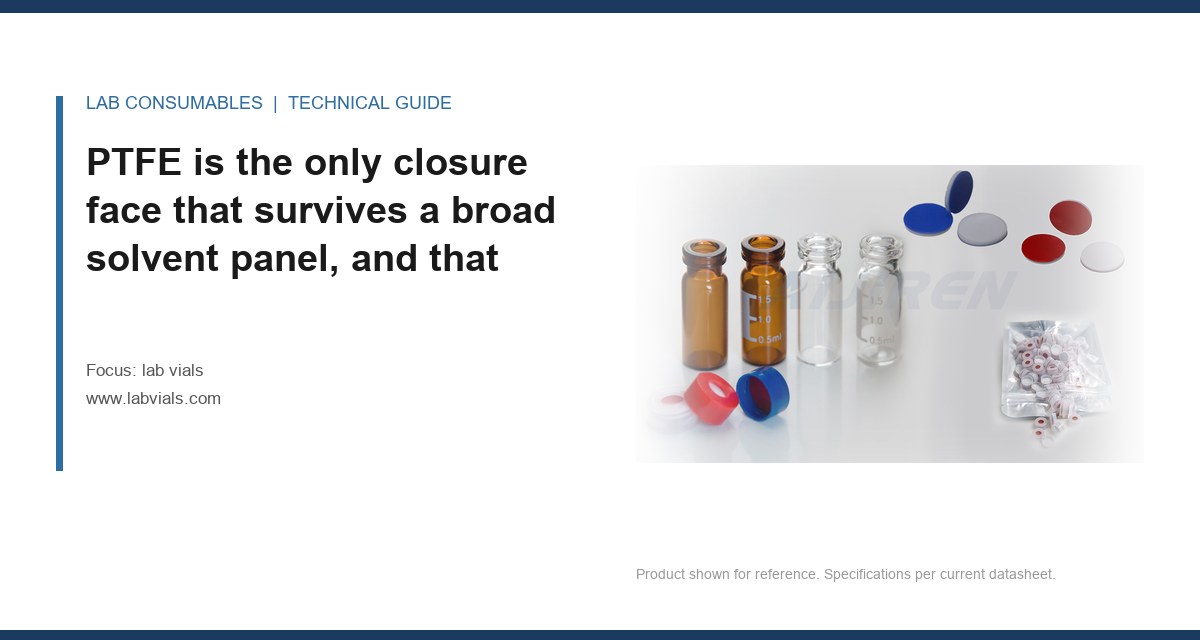
PTFE is the only closure face that survives a broad solvent panel, and that is the whole reason it is standard
Polytetrafluoroethylene is inert to almost everything an analytical lab will put in front of it. It has no measurable swell in toluene, dichloromethane, tetrahydrofuran, dimethyl sulfoxide, or concentrated nitric acid. Continuous service temperature runs from about -200 °C to +260 °C. Water absorption is below 0.01%. There is no plasticizer to leach, no oligomer to extract, and no pH window worth quoting because it does not meaningfully degrade between pH 0 and pH 14.
That inertness is also its limitation. PTFE is a fluoropolymer with a low coefficient of friction and no elastic memory. A pure PTFE disc does not seal by compression the way an elastomer does. It seals by being deformed against the glass lip, and once the cap is removed it does not spring back. This is why almost every PTFE closure in a working lab is a laminate: a thin PTFE facing bonded to a silicone or EPDM core. The PTFE faces the sample and does the chemical work; the elastomer behind it provides the resilience that lets the seal survive being pierced and re-seated.
Where a pure PTFE-faced laminate wins outright
- Halogenated solvents (DCM, chloroform, chlorobenzene) in headspace and purge-and-trap work. Silicone swells 15 to 25% in DCM within hours, and the swell lifts the seal off the lip.
- Aromatic and aliphatic hydrocarbons at any concentration above trace.
- Strong acids and bases, including the 1:1 nitric acid used in metals digestion.
- Any method with a long queue time between preparation and injection, because PTFE does not adsorb and does not permeate.
The failure mode when you use PTFE where it does not belong is mechanical, not chemical. A PTFE-faced septum is harder to pierce than an all-silicone one, and a 22-gauge needle that has already been used four times will core it. I have seen a 0.45 mm PTFE facing produce a punched-out disc that sat in the bottom of a 2 mL autosampler vial and blocked the needle on the next injection. The fix is a fresh needle every 50 to 100 punctures on a PTFE laminate, and a check of your needle gauge against the septum thickness. A 0.9 mm PTFE/silicone laminate takes a 23-gauge needle cleanly; a 1.5 mm one does not.
Silicone is the best general-purpose septum and the worst choice for exactly the analytes you care about
Silicone (polydimethylsiloxane, PDMS) is the default septum core because it has excellent compression set resistance, a wide temperature range of about -60 °C to +200 °C, and it re-seals around a needle well enough to survive 50 to 100 punctures in a screw-thread cap. It is also the material most likely to ruin a volatile method.
The mechanism is permeation and partitioning. PDMS is a hydrophobic elastomer with high free volume. Small nonpolar molecules dissolve into it. If you are running a method that quantifies trace volatiles, the septum becomes a second, competing phase. The analytes partition into the silicone, and the equilibrium concentration in the headspace above your sample drops. This is not a leak. The vial is sealed. The analyte is simply sitting in the septum instead of the gas phase.
The second mechanism is siloxane bleed. At elevated inlet temperatures (250 to 300 °C), silicone septa release cyclic siloxanes (D3 through D10) that show up as a repeating mass-series pattern in GC-MS. If your method has a scan window that covers m/z 281, 355, or 429, you will see them. A bleed check on a new lot is worth the ten minutes: run a blank injection with the septum in place and look at the siloxane envelope.
Temperature is a hard ceiling, not a suggestion
Silicone at 200 °C in a headspace oven starts to degrade. Continuous operation above 180 °C accelerates compression set, and a septum that has taken a set no longer seals after the first puncture. If your headspace oven runs at 150 °C or above, specify a PTFE-faced silicone rather than a plain silicone septum, and if it runs above 200 °C, you are outside the range of silicone entirely and should be looking at a PTFE-faced EPDM or a laminated PTFE-only closure. The septa range at septacaps.com lists the continuous and peak ratings per grade, and the peak rating is not the number to design to.
Field case: the 18% drop that was not a leak
The opening scene is a real one. The lab had been running EPA 8260 with plain silicone septa on 40 mL VOA vials for years. The drift appeared only on low-concentration samples with long hold times in the autosampler tray. The measurement that identified it was a simple experiment: the same standard prepared in two sets of vials, one with silicone and one with PTFE-faced silicone, held at 4 °C and injected at 0, 2, 4, and 6 hours. The silicone set lost 6% of the bromofluorobenzene at 2 hours, 12% at 4, and 18% at 6. The PTFE set lost less than 2% across the whole window. The fix was a switch to PTFE-faced silicone septa and a 4-hour maximum queue time. The method did not change. The vial did.
EPDM is the answer for aqueous and alkaline matrices and the wrong answer for hydrocarbons
Ethylene propylene diene monomer is a saturated-backbone elastomer with no double bonds in the polymer chain, which is why it resists oxidation, ozone, and steam far better than natural rubber or nitrile. Its temperature window is roughly -50 °C to +150 °C, lower than silicone at the top end. It has excellent resistance to water, steam, dilute acids, and alkaline solutions up to about pH 12, and it is the right choice for aqueous matrices where silicone’s permeability to small molecules is a liability.
EPDM’s weakness is hydrocarbons. It swells badly in nonpolar solvents, and the swell is not recoverable. A 10% swell in toluene will lift the seal off the glass lip and produce a leak that looks like a capping problem. If you are running a method with an aromatic or aliphatic solvent, EPDM is the wrong material regardless of how good the aqueous performance looks on paper.
The other EPDM issue is extractables. Standard EPDM grades contain curing agents, accelerators, and fillers that can leach into aqueous samples. For trace metals work or ion chromatography, specify a low-extractable EPDM grade and run a blank. If your method is EPA 300.0 or 200.8, the blank is not optional.
pH is a selection axis, not a footnote
Most labs never think about pH when they pick a septum. They should. Silicone is broadly pH-tolerant but hydrolyzes slowly at pH above 12. EPDM handles alkaline conditions better but degrades below pH 2 over long contact. PTFE does not care. If your method involves a strong acid or base digestion, the septum is a PTFE laminate by default, and the only question is what the backing elastomer should be.
Laminate construction is where most selection errors actually happen
The word “laminate” on a spec sheet tells you almost nothing. A PTFE/silicone laminate and a PTFE/EPDM laminate behave completely differently in the same method, and the PTFE facing thickness matters as much as the backing. A 0.1 mm PTFE facing is enough to protect against solvent contact but thin enough that a needle will push through it cleanly. A 0.5 mm facing is more chemically robust but harder to pierce and more prone to coring.
The failure I see most often is a lab that specifies “PTFE septum” and receives a laminate with a 0.05 mm facing over a soft silicone core. The facing is so thin that the needle drags it into the vial, or the facing delaminates at the puncture site after a few injections and the silicone core is exposed to the sample. The measurement that catches this is a simple visual inspection of the septum after 20 punctures: if the PTFE facing has lifted at the puncture, the laminate is not fit for a multi-injection sequence.
Comparison table: closure material against solvent, pH, and temperature
| Material | Solvent resistance | pH range (continuous) | Temperature window | Typical failure when misapplied |
|---|---|---|---|---|
| PTFE (facing) | Inert to nearly all solvents; no measurable swell | 0 to 14 | -200 °C to +260 °C | Coring at the puncture site; poor re-seal after cap removal |
| Silicone (PDMS) | Poor against nonpolar solvents; swells 15-25% in DCM | 2 to 12 (hydrolyzes above 12) | -60 °C to +200 °C (design to 180 °C) | Analyte partitioning and siloxane bleed; compression set above 180 °C |
| EPDM | Excellent aqueous; poor against hydrocarbons | 2 to 12 | -50 °C to +150 °C | Swell and seal lift in aromatic solvents; extractables in trace metals |
| PTFE/silicone laminate | Broad solvent panel; facing protects the core | 0 to 14 at the face | -60 °C to +200 °C | Facing delamination if thinner than 0.1 mm; coring with blunt needles |
| PTFE/EPDM laminate | Broad solvent panel plus better aqueous sealing | 0 to 14 at the face | -50 °C to +150 °C | Lower temperature ceiling than silicone; core swell if facing is breached |
A decision rule you can apply at the bench without a materials database
Start with the solvent, not the temperature. If the method uses a halogenated or aromatic solvent in any significant proportion, the answer is a PTFE-faced laminate, full stop. If the method is aqueous and the analytes are volatile, the answer is PTFE-faced silicone, because the PTFE protects the sample from the silicone and the silicone provides the seal. If the method is aqueous, nonvolatile, and runs at or below 150 °C, EPDM is a reasonable and often cheaper choice. If the method involves strong acid or base digestion, the answer is PTFE-faced, and the backing elastomer matters only for mechanical resilience.
Temperature then narrows the choice. Above 180 °C, silicone is out. Above 150 °C, EPDM is out. Above 200 °C, you are into PTFE-only closures, and you accept the mechanical trade-offs that come with them. Below 0 °C, silicone stays flexible longer than EPDM, which is why cold-room and refrigerated autosampler applications default to silicone cores.
Then check the puncture count. A septum rated for 50 punctures is a single-use item in a multi-injection sequence. A septum rated for 100 punctures is a working-day item. If your sequence runs 96 injections through one vial, you need a septum rated for at least 100 punctures, and you need to replace the needle before the septum. The two consumables age together and the septum always fails first.
Field case: the alkaline digestion that ate the septum
A metals lab running a modified EPA 3050B digestion (nitric acid and hydrogen peroxide) had no trouble. They added an alkaline digestion step for a client’s soil samples (EPA 3060A, hexavalent chromium) and started seeing chromium results that were 10 to 15% low against a certified reference material. The vial was a 50 mL screw-thread with a plain silicone septum. The measurement that identified it was a septum blank: the septa were soaked in the alkaline digest solution for 24 hours and the leachate analyzed by IC. The silicone had hydrolyzed at pH 13 and released silicates that interfered with the chromium complexation step. The fix was a PTFE-faced septum on the same vial. The chromium results came back into control on the next batch.
Troubleshooting checklist: match the symptom to the material before you change anything else
- Response drift over a long sequence, no leak: analyte partitioning into a silicone septum. Switch to PTFE-faced silicone and shorten queue time.
- Repeating mass-series peaks in GC-MS: siloxane bleed from silicone at high inlet temperature. Check the septum grade and the inlet temperature; a PTFE-faced septum reduces but does not eliminate bleed.
- Seal lift or cap loosening after hours in the tray: elastomer swell in a nonpolar solvent. Switch to PTFE-faced and check the cap torque (typically 0.5 to 1.0 N·m for a 24 mm screw cap, and follow the manufacturer’s spec rather than a generic number).
- Punched-out disc in the vial bottom: coring of a PTFE facing by a blunt or oversized needle. Replace needles every 50 to 100 punctures and check gauge against facing thickness.
- Low recovery of trace metals or anions: extractables from an EPDM or standard-grade silicone. Run a septum blank and switch to a low-extractable grade.
- Septum hard and flattened after a headspace run: compression set above the material’s continuous rating. Reduce oven temperature or move to a higher-temperature material.
- Chromatographic interference only in alkaline methods: silicone hydrolysis. Switch to PTFE-faced.
For method-specific guidance on the closure side, the technical resources at Restek and the consumables documentation at Agilent and Thermo Fisher are worth reading against your own method. The regulatory frame for waste and environmental methods is at EPA SW-846, and it is the source to check when a method’s container requirements are ambiguous. The full lab vials range at labvials.com and the Aijiren closure grades are worth cross-referencing against the table above before you place an order.
What the spec sheet should tell you, and what to ask if it does not
A closure spec sheet that gives you only the polymer name is not enough. Ask for the facing thickness in millimetres, the continuous and peak temperature ratings separately, the recommended puncture count, the pH range for continuous contact, and the extractables profile (or at least the curing system) for the backing elastomer. If the supplier cannot give you the facing thickness, the laminate is not specified well enough to design a method around, and you should treat it as a generic item.
The decision rule is this: pick the material that is inert to your solvent first, then check that it holds your temperature window with margin, then confirm the puncture count exceeds your sequence length by at least a factor of two. If two materials pass all three checks, pick the one with the higher continuous temperature rating, because temperature is the variable that drifts between the method as written and the method as run. Everything else is a detail.
References & further reading
Related resources from our lab consumables network:
- Lab Vials at labvials.com
- Aijiren Brand at aijirenvials.com
- Voa Vial at voavial.com
- Septa at septacaps.com
External references and standards: